

Welcome to PersonalFN’s weekly analysis on diversified equity mutual funds! In this issue, we have analysed HDFC Flexi Cap Fund, highlighting its performance, peer comparison, investment strategy, fundamentals, portfolio, and suitability.
HDFC Flexi Cap Fund is a Flexi Cap Fund, that prioritises unlocking the long-term potential of carefully selected, fundamentally strong stocks. With a proven track record of delivering impressive returns, it has consistently rewarded investors, especially following a period of sluggish growth, demonstrating the value of patience.
What is the growth of Rs 10,000 invested in HDFC Flexi Cap Fund five years ago?
Past performance is not an indicator of future returns
Data as of November 18, 2024
(Source: ACE MF, data collated by PersonalFN)
The erstwhile HDFC Equity Fund, now known as HDFC Flexi Cap Fund, holds the distinction of being among the pioneering schemes in the Flexi Cap Fund category. Incepted in January 1995, the fund has demonstrated an impressive CAGR of approximately 19%, with its AUM soaring to a substantial Rs 64,929 crore. Originally structured as a Multi Cap fund with a preference for large caps, HDFC Flexi Cap Fund underwent a reclassification in January 2021, transforming into a Flexi Cap Fund to adhere to SEBI’s revised category definition. Notably, the fund has constantly employed a dynamic investment approach, allocating across market caps depending on the available opportunities, but with a bias towards large caps. Consequently, the transition to a Flexi Cap fund category did not have any impact on the underlying investment philosophy of the scheme.
HDFC Flexi Cap Fund adopts a blend of growth and value-driven investment strategies and avoids taking position on momentum-driven bets, even if it results in short-term underperformance. The fund encountered challenges during two periods: 2015-16 and from 2019 to 2020. These challenges were primarily attributed to its heightened exposure to high-conviction bets on Infotech, Engineering, and PSU stocks, which fell out of favour during these periods. Nonetheless, the fund experienced a resurgence as its investments in PSUs, Infotech, Pharma, and Engineering sectors thrived in the latter half of 2020. Moreover, its significant exposure to Banking & Finance stocks enabled it to benefit from the robust growth in the segment. As a result, it now stands among the top quartile performers in the category across various time frames.
Over the last five years, HDFC Flexi Cap Fund has demonstrated a CAGR of approximately 23.3%, outperforming its benchmark Nifty 500 – TRI, which grew at a rate of about 19%. An initial investment of Rs 10,000 in HDFC Flexi Cap Fund five years ago would have now been valued at Rs 28,531 surpassing the benchmark’s valuation of Rs 23,843 for a similar investment over the same period.
How has HDFC Flexi Cap Fund performed on a rolling return basis?
| Scheme Name | Corpus (Cr.) | 1 Year | 2 Year | 3 Year | 5 Year | 7 Year | Std Dev | Sharpe |
| Quant Flexi Cap Fund | 7,514 | 51.93 | 32.05 | 29.82 | 32.88 | 23.48 | 18.53 | 0.24 |
| JM Flexicap Fund | 4,722 | 56.95 | 36.54 | 29.05 | 25.59 | 20.00 | 15.58 | 0.36 |
| Bank of India Flexi Cap Fund | 1,930 | 56.27 | 32.28 | 27.49 | — | — | 16.39 | 0.28 |
| HDFC Flexi Cap Fund | 64,929 | 40.37 | 29.65 | 26.87 | 22.03 | 18.13 | 13.76 | 0.35 |
| Franklin India Flexi Cap Fund | 17,450 | 40.46 | 25.91 | 22.77 | 21.82 | 16.92 | 13.99 | 0.24 |
| ICICI Pru Flexicap Fund | 16,768 | 39.48 | 26.30 | 22.72 | — | — | 12.99 | 0.31 |
| Edelweiss Flexi Cap Fund | 2,365 | 41.61 | 25.87 | 21.90 | 21.30 | 18.18 | 14.82 | 0.25 |
| Parag Parikh Flexi Cap Fund | 81,919 | 37.87 | 24.16 | 21.53 | 25.25 | 21.09 | 11.96 | 0.25 |
| HSBC Flexi Cap Fund | 4,943 | 42.08 | 26.65 | 21.10 | 19.28 | 15.20 | 14.07 | 0.26 |
| Shriram Flexi Cap Fund | 137 | 39.69 | 23.43 | 19.06 | 17.50 | — | 14.84 | 0.17 |
| Nifty 500 – TRI | 34.90 | 21.67 | 18.82 | 19.27 | 16.02 | 14.62 | 0.18 |
The securities quoted are for illustration only and are not recommendatory.
Returns are on a rolling basis and in %. Direct Plan-Growth option. Those depicted over 1-Yr are compounded annualised. Risk ratios are calculated over a 3-year period assuming a risk-free rate of 6% p.a.
Data as of November 18, 2024
(Source: ACE MF, data collated by PersonalFN)
While HDFC Flexi Cap Fund has a commendable long-term performance history, it has encountered periods of short to medium-term underperformances. On a rolling return basis, over the last 2-years and 3-years, the fund has delivered an impressive CAGR of around 29.7% and 26.9%, surpassing both its benchmark and the category average by a substantial margin of around 6-8 percentage points CAGR. Notably, many of its prominent peers have struggled to match the benchmark performance during this period. Its extraordinary performance in recent years has significantly improved its long-term returns as well, positioning it among the top quartile performers in the category across various time frames while also generating noticeable alpha over the benchmark.
HDFC Flexi Cap Fund has exhibited lower volatility than the category average and the benchmark. Moreover, it has adequately rewarded its investors by recording higher risk-adjusted returns, as reflected in its superior Sharpe ratio of 0.35, which significantly exceeds that of the benchmark, and is currently among the best in the category.
[Read: Flexi Cap Funds v/s Multi Cap Funds: Which Is Better at a Market High?]
What is the investment strategy of HDFC Flexi Cap Fund?
Categorised as a Flexi Cap Fund, HDFC Flexi Cap Fund is mandated to invest at least 65% of its assets in Indian equities. It has the flexibility to invest without any market cap or sector restriction. Accordingly, it aims to create a diversified portfolio spread across major industries, economic sectors, and market capitalization that offer an acceptable risk-reward balance. HDFC Flexi Cap Fund follows a blend of growth and value styles of investing to generate optimal returns. The scheme predominantly invests in companies that:
a) Are likely to achieve above-average growth
b) Enjoy distinct competitive advantages, and
c) Have superior financial strength
HDFC Flexi Cap Fund maintains a large-cap biased portfolio wherein it invests 70-85% of its assets, with the remaining in mid-cap and small-cap stocks. The fund has high conviction in most of the stocks in its portfolio and holds them with a long-term view. Accordingly, it has recorded a low turnover ratio of about 30-40% in the last two years.
What are the top portfolio holdings in HDFC Flexi Cap Fund? 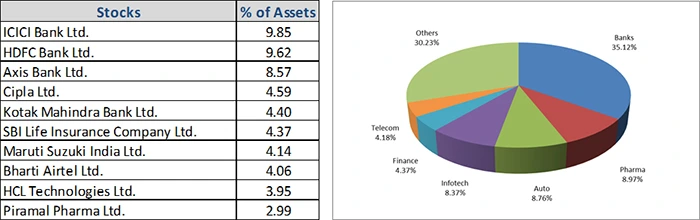
Holding in (%) as of October 31, 2024
(Source: ACE MF, data collated by PersonalFN)
HDFC Flexi Cap Fund usually holds around 45-55 stocks spread across market caps and sectors. As of October 31, 2024, the fund held a compact portfolio of 50 stocks with the top 10 stocks accounting for about 56.6% of its assets. Popular large-cap names such as ICICI Bank, HDFC Bank, Axis Bank, Cipla, and Kotak Mahindra Bank currently form part of its top holdings. SBI Life Insurance Company, Maruti Suzuki India, Bharti Airtel, HCL Technologies, and Piramal Pharma are among the other stocks that form part of the fund’s top 10 holdings. The fund has limited the exposure to individual stocks in the mid-cap and small-cap segments to under 3%.
In the last two years, HDFC Flexi Cap Fund benefitted the most from its holdings in Hindustan Aeronautics, Bharti Airtel, ICICI Bank, L&T, Mahindra & Mahindra, SBI, HCL Technologies, and Lupin which together contributed nearly 28% to its absolute gains. Kalpataru Projects International, Bank of Baroda, HDFC Bank, Infosys, Axis Bank, SBI Life Insurance Company, and Tech Mahindra were among the other top contributors to its gains. Meanwhile, it booked profit in BEML Land Assets, Coforge, Interglobe Aviation, ONGC, and NTPC, among others.
In terms of sectors, HDFC Flexi Cap Fund’s portfolio is skewed towards Banking & Finance stocks that collectively form around 39.5% of its assets. It holds substantial allocations in Auto & Auto Ancillaries, Pharma, and Infotech that form another 28.6% of its assets. The fund also holds diversification to Telecom, Healthcare, Consumption, and Engineering, among others. Its portfolio has a well-balanced allocation to cyclical, defensive, and sensitive sectors.
Is HDFC Flexi Cap Fund suitable for my investment goals and risk tolerance?
HDFC Flexi Cap Fund has staged an impressive turnaround in recent years, reclaiming its position among the top performers in the Flexi Cap Fund category. While it may not excel during bear markets, the fund’s performance shines in bullish market phases, offering investors attractive rewards over complete market cycles.
Due to its high-conviction approach, HDFC Flexi Cap Fund might experience periods of underperformance in the short to medium term, particularly when its high-conviction bets are out of favour, or during momentum-driven market upswings. However, its focus on creating a well-diversified portfolio of fundamentally sound stocks positions it for potential recovery with superior gains during bull phases. Notably, the fund has established a dependable track record of delivering reasonable risk-adjusted returns over extended time frames.
HDFC Flexi Cap Fund is suitable for investors seeking a Flexi Cap Fund focused on selecting high-conviction stocks with an investment horizon of at least 5 to 7 years.
Watch this video to find out the top Flexi Cap Funds with highest SIP returns:
Note: This write up is for information purpose and does not constitute any kind of investment advice or a recommendation to Buy / Hold / Sell a fund. Returns mentioned herein are in no way a guarantee or promise of future returns. As an investor, you need to pick the right fund to meet your financial goals. If you are not sure about your risk appetite, do consult your investment consultant/advisor. Mutual Fund Investments are subject to market risks, read all scheme related documents carefully. Registration granted by SEBI, Membership of BASL and certification from NISM no way guarantee performance of the intermediary or provide any assurance of returns to investors.
The securities quoted are for illustration only and are not recommendatory.
This article first appeared on PersonalFN here


